

Is Owning a Laundromat Worth It? The Honest Answer Every Aspiring Entrepreneur Needs
If you've spent any time on social media lately, you've probably seen the content — the entrepreneur standing in front of a shiny row of washing machines talking about passive income, financial freedom, and recession-proof businesses. It sounds almost too good.
So you did what any smart person would do: you started asking questions.
Is owning a laundromat actually worth it? How much do laundromat owners really make? Can it actually run without me being there every day? And is there a smarter way to get into this business than just going it alone?
These are exactly the right questions. And you deserve honest, complete answers .
So let's dig in.
Why Everyone Seems to Be Talking About Laundromats Right Now
The laundromat conversation has been heating up for good reason.
The U.S. laundry facilities and dry-cleaning services market was valued at $16.60 billion in 2025 and is projected to reach $22.51 billion by 2030 — a compound annual growth rate of 6.3%.
Globally, the coin-operated laundry market was valued at over $17.5 billion in 2022 and is expected to double to nearly $35.84 billion by 2030.
That's not the profile of a niche or fading industry. That's a growing, essential market that serves virtually every American household — and the numbers back it up.
But market size alone doesn't tell you if you will make money. Let's get to that.
The Real Numbers: How Much Do Laundromat Owners Actually Make?
Here's what the industry data consistently shows:
A well-run laundromat can generate between $15,000 and $300,000 in annual cash flow, depending on size, location, and model
The average ROI for laundromats sits between 20–35% annually — one of the highest in any franchise category
The industry boasts an impressive 95% business success rate over five years, far above the national average for small businesses
Modern laundromats using card-based and app-based payment systems report higher revenue per customer visit than traditional coin-operated stores
Of course, these numbers don't happen automatically. Like any business, a laundromat's financial performance depends heavily on where it is, how it's run, and what kind of experience it delivers to customers.
A well-located, well-designed, well-operated laundromat is an exceptional business. A poorly positioned one with aging equipment and no marketing strategy is a very different story.
That distinction matters a lot — and it's exactly why the franchise model changes the conversation so significantly.
Let's Talk About the "Passive Income" Debate
Spend five minutes on any laundromat forum or comment section and you'll find the debate raging: Is a laundromat truly passive income?
The honest answer sits somewhere in the middle — and it depends entirely on how you own your laundromat.
The Independent Laundromat Reality
Independent laundromat owners — people who open or buy locations entirely on their own — often discover that the business requires more active involvement than they initially anticipated. Equipment breaks down. Coin jams happen. Customers have problems. Floors need mopping. Cash needs collecting.
Without established systems, vendor relationships, or experienced support, the owner becomes the default solution to every problem. That's not passive income. That's a job with overhead.
This is the reality a lot of the social media content glosses over — and it's important to acknowledge it honestly.
How the Franchise Model Shifts the Equation
Here's where the picture changes significantly.
A franchise model like Laundry Luv is built from the ground up to address the very operational challenges that make independent ownership difficult:
Technology-enabled operations — app-based payments, remote machine monitoring, and digital reporting mean you can manage performance without being on-site 24/7
Trained team members and clear operational playbooks eliminate the guesswork from day-to-day management
Established vendor and maintenance relationships mean machine problems get resolved quickly — without you being the one making the calls
Proven systems mean you're not reinventing the wheel for marketing, pricing, or customer retention
The result? A business that operates more like a true semi-absentee income asset — one that demands your attention and leadership without demanding your physical presence every single day.
That's a meaningful difference.
Laundromat Franchise vs. Going Independent: A Straight Comparison
If you're seriously considering entering the laundry industry, you'll eventually face this choice. Here's an honest side-by-side:
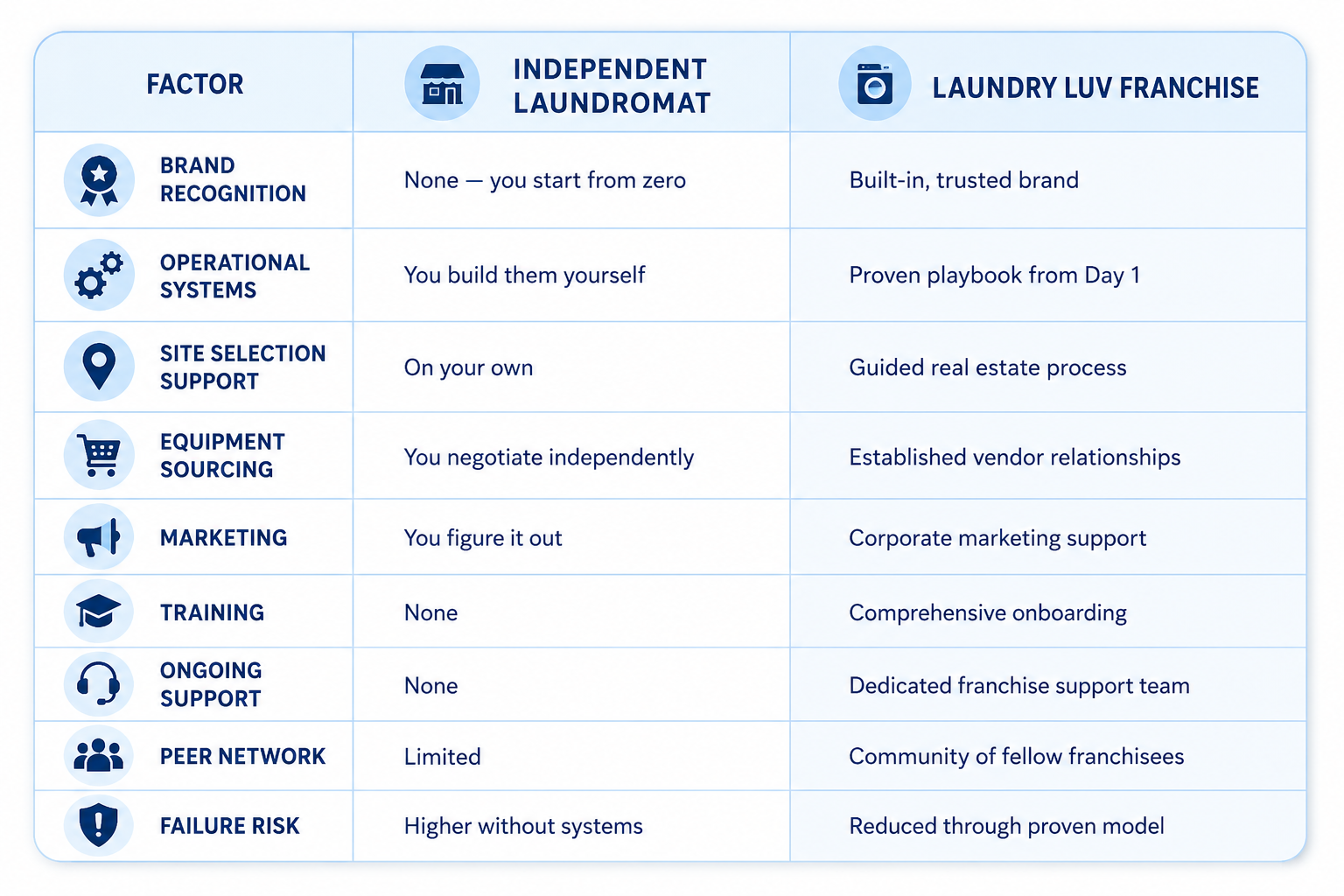
Going independent isn't wrong — but it is harder, especially for first-time business owners. The franchise model trades a portion of your revenue for something incredibly valuable: a dramatically shortened learning curve and a dramatically lower risk profile.
For most entrepreneurs entering the laundry industry for the first time, that trade is well worth it.
What Makes a Laundromat Successful (or Not)?
Before you make any investment decision, it's worth understanding the variables that separate thriving laundromats from struggling ones.
The biggest drivers of success:
📍 Location, Location, Location
High-traffic areas near dense rental housing, apartment complexes, and urban neighborhoods are the sweet spots. Areas with a high percentage of renters — who typically lack in-unit washers and dryers — represent your core customer base.
🏗️ Quality of the Experience
This is where the industry is undergoing the biggest transformation. Customers who walk into a clean, modern, well-lit store with reliable machines and a welcoming atmosphere come back — and they tell their neighbors. Customers who walk into a dated, dingy store with broken machines don't. The experience is the product.
⚙️ Equipment Reliability
Laundromat revenue stops when machines stop. Modern equipment with remote diagnostics, proactive maintenance schedules, and fast repair relationships is the difference between consistent cash flow and costly downtime.
📲 Technology Integration
The best-performing modern laundromats have moved beyond quarters. App-based payments, loyalty programs, and digital customer communication drive higher per-visit revenue and stronger customer retention.
👥 Community Connection
The laundromats that become true community institutions — places where people feel seen, welcomed, and valued — generate the kind of organic loyalty that no amount of advertising can buy.
Laundry Luv is designed to win on every single one of these dimensions. That's not an accident — it's the architecture of the business model.
Why 2026 Is a Smart Time to Enter the Laundry Industry
Timing matters in business, and right now the laundry industry offers a compelling entry window for several reasons:
1. Apartment living is surging. Homeownership rates are declining as housing costs remain elevated, pushing more Americans into rental housing — and rental housing means laundromat customers. This demographic trend isn't reversing anytime soon.
2. Consumer expectations are rising. The aging, coin-only laundromat is becoming obsolete. Entrepreneurs who enter the market now with modern, tech-enabled, beautifully designed locations are positioned to capture market share from outdated competitors.
3. The industry is consolidating toward quality. Just as fast-casual dining disrupted greasy diners, modern laundromat franchises are disrupting the outdated self-service laundry experience. Being an early mover in this evolution is a strategic advantage.
4. Essential services remain inflation-resistant. While discretionary businesses get squeezed when prices rise, essential services like laundry hold their ground. Consumers cut vacations before they stop washing clothes.
How Laundry Luv Is Reimagining What Laundromat Ownership Looks Like
Laundry Luv wasn't built to be just another laundromat franchise. It was built to be what laundromats should have always been.
Every element of the Laundry Luv experience — from the store design to the customer app to the franchisee support model — was designed with one question in mind: What would make this genuinely great?
That means:
Spaces people actually want to be in — bright, welcoming, clean, designed for comfort during a 45-minute visit
Technology that makes ownership easier and revenue more predictable — remote monitoring, cashless transactions, real-time performance data at your fingertips
A franchise system built for real entrepreneurs — not former laundry technicians, not industry insiders, but driven people who want a real business with real support
Community-first positioning — because the laundromat that becomes a neighborhood institution wins for decades, not just quarters
This is what separates Laundry Luv from an average laundromat — and from an average franchise opportunity.
So — Is It Worth It?
Yes. But with one critical condition.
Owning a laundromat is absolutely worth it when you:
✅ Choose the right location in a well-researched market
✅ Operate with modern equipment and technology
✅ Deliver a customer experience that builds loyalty
✅ Have reliable systems, support, and people in place
✅ Enter through a franchise model that sets you up with all of the above
When those conditions are met — and Laundry Luv is designed to help you meet every one of them — laundromat ownership offers some of the most compelling economics available to entrepreneurs today: recurring revenue, essential demand, scalable operations, and real community impact.
If you're an entrepreneur looking for a business that works as hard as you do, Laundry Luv is worth a serious conversation.
📣 Ready to Get the Full Picture?
We believe in giving entrepreneurs the real information they need to make confident decisions. If you're curious about what Laundry Luv franchise ownership looks like — the investment, the process, the support, and the opportunity — we'd love to connect.
Laundryluvfranchise.com
No pressure. Just the full picture.
❓ 9. FAQ SECTION
Q: Is a laundromat really passive income? A: The honest answer is "semi-passive." Independent laundromats require significant owner involvement, especially early on. Franchise models like Laundry Luv — with proven systems, technology, and trained staff — allow for a far more semi-absentee ownership structure, but no business is 100% passive.
Q: Is a laundromat a good investment in 2026? A: Yes, for the right entrepreneur in the right market. The laundry services industry is growing, demand is essential and recession-resistant, and modern franchise models have dramatically improved the investment profile of laundromat ownership compared to previous generations.
Q: What's the difference between a laundromat franchise and an independent laundromat? A: A franchise gives you a proven brand, operational systems, training, marketing support, and an established network. An independent laundromat offers more flexibility but requires you to build everything from scratch — a harder path, especially for first-time owners.
Q: Do laundromats do well during recessions? A: Historically, yes. Laundry is an essential service that doesn't get significantly cut during economic downturns. In some cases, laundromat usage actually increases during recessions as consumers seek more affordable alternatives to dry cleaners or in-home appliance upgrades.
Q: How do I know if my market is right for a laundromat franchise? A: Key indicators include high rental housing density, underserved laundromat supply in the area, strong foot traffic corridors, and growing population. Laundry Luv's franchise development team conducts market analysis to help candidates evaluate their target territories.
Q: What is Laundry Luv's franchise model? A: Laundry Luv is a modern laundromat franchise built around beautiful store design, technology-enabled operations, and community-centered customer experiences. It's designed for semi-absentee ownership, making it accessible to working professionals, first-time business owners, and multi-unit investors alike.

